
Shape • Parameters • Moments
Explore Probability
Distributions
Learn the shape, parameters, moments, and real-world uses of common and advanced probability distributions through clear, visual explanations.
Can't find the distribution you need?
Send a request and our editorial team will add it to the review queue.
Featured distributions
Compare foundational models for continuous and discrete random variables.
Showing 1–6 of 65 distributions
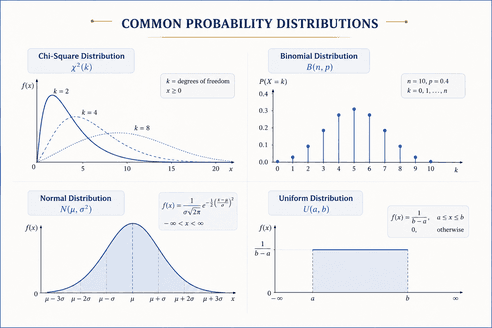
Normal Distribution
The bell curve: history from de Moivre through Gauss and Laplace, the density and CDF, what location and scale mean geometrically, the full moment/entropy/hazard/quantile property list, maximum-likelihood estimation of the mean and variance, and how to simulate draws via the Box–Muller transform.
Exponential Distribution
The waiting-time distribution: history from Erlang's queueing theory and radioactive decay, the memoryless property, rate-vs-scale parameterization, the full property list (including its defining constant hazard function), maximum-likelihood estimation of the rate with its small-sample bias, and exact simulation via inverse-transform sampling.
Binomial Distribution
The count of successes in n independent trials: history from Bernoulli through de Moivre's normal approximation, the PMF and why discrete hazard/quantile functions are defined differently than in the continuous case, the full property list, maximum-likelihood estimation of p (exactly unbiased, exactly efficient), and simulation as a direct sum of Bernoulli draws.
Poisson Distribution
The rare-event count distribution: history from Poisson's binomial limit through Bortkiewicz's horse-kick data, equidispersion (mean equals variance, and in fact every cumulant), the full property list, maximum-likelihood estimation of the rate, and exact simulation via Knuth's algorithm.
Uniform Distribution
The flat-density distribution: history from Laplace's principle of indifference through the probability integral transform underlying every other simulation method in this series, order-statistic maximum-likelihood estimation (with no calculus involved), and why Fisher information doesn't apply in the usual sense when support depends on the parameters.
Gamma Distribution
The waiting-time-for-the-n-th-event distribution: history from Euler's Gamma function through Erlang's queueing generalization of the Exponential, shape-rate vs. shape-scale parameterization pitfalls, the full property list including the Fisher information matrix, maximum-likelihood estimation via a transcendental digamma equation, and simulation via the Erlang sum-of-Exponentials construction.
Map of Probability Distributions
See how these distributions relate to each other — special cases, limiting cases, transformations, mixtures, and conjugate priors — across 8 focused panels.
Compare distributions side by side
Pick 2-4 distributions, adjust their parameters, and see how their shapes and moments compare in real time.